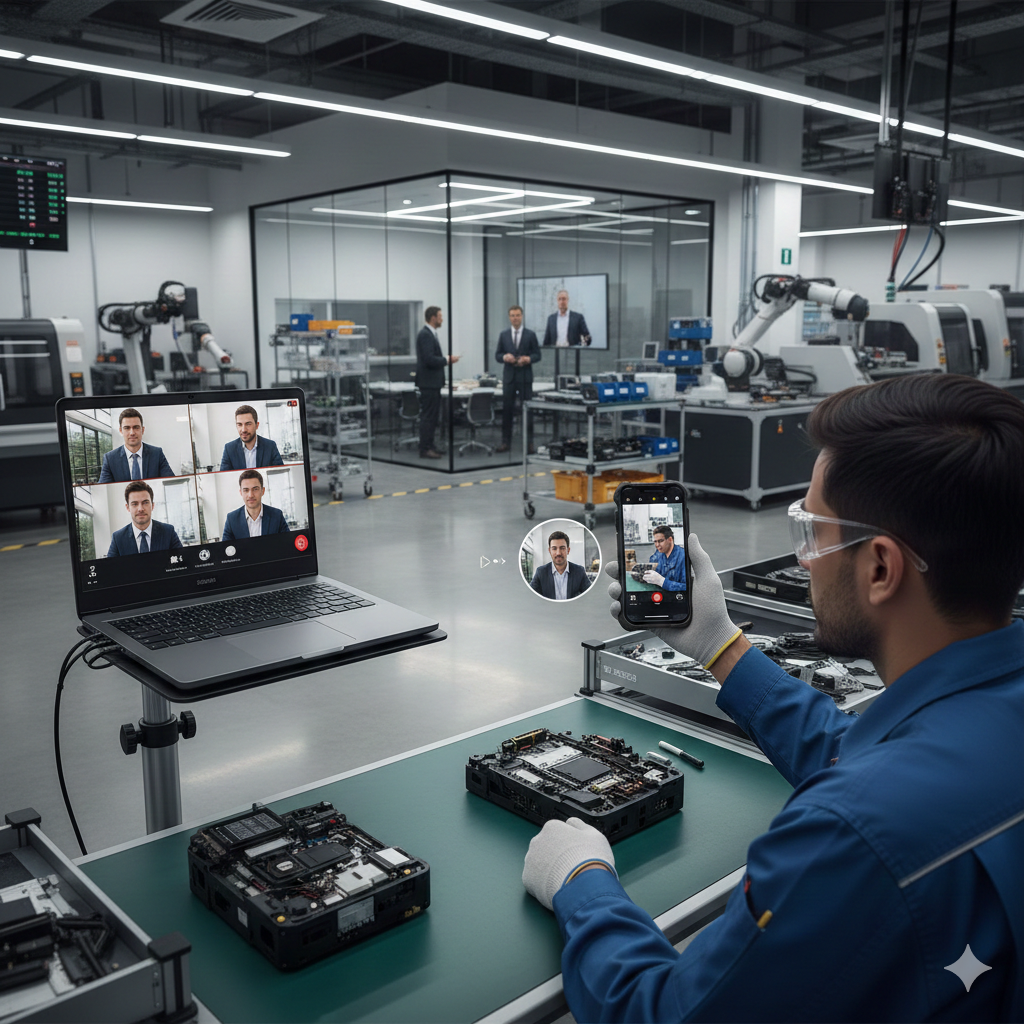
Why even bother with a Virtual Gemba Walk
A Gemba Walk does not exist because leaders enjoy walking the shopfloor. It exists because decisions improve when leaders see the work where it happens.
In a global, remote, and time-constrained reality, leaders are often far from the physical Gemba. Products are designed in one country, piloted in another, reviewed somewhere else. Travel is slow, expensive, and sometimes impossible.
That is where a Virtual Gemba Walk earns its place.
Not as a substitute for being there.
Not as a routine.
But as a deliberate leadership tool when distance is real and insight is urgent.
What a Virtual Gemba Walk is
A Virtual Gemba Walk is a live, structured observation of work as it happens, conducted remotely, with the same intent as a physical Gemba Walk.
It focuses on:
- Seeing the process, not hearing explanations
- Observing conditions, flow, and outcomes
- Understanding how work is actually performed
- Asking questions to learn, not to judge
The “virtual” part changes the medium — not the purpose.
What it is not
A Virtual Gemba Walk is not:
- A status meeting
- A presentation or slide review
- A KPI or dashboard discussion
- A remote audit
- A performance review
If slides are shared, if people explain instead of showing, or if leaders start solving problems live — it is no longer a Gemba Walk.
A real case: why Virtual Gemba worked
A new product was developed in India based on a Dutch design.
Design and development were done in Enschede, the Netherlands.
The first pilot tyres were produced in Kalamassery, India, and shipped to Enschede.
During inspection, several imperfections were identified. A detailed and technical inspection report was prepared and shared with the Head of R&D. The findings were clear, documented, and supported with pictures.
Still, the Indian team wanted more.
They did not want another report.
They wanted to see what was being seen.
They wanted to understand how inspections were performed and why certain observations mattered.
The CQO requested a Virtual Gemba Walk.
The intent was simple:
“Do the inspection again — but let us be there with you.”
This was during COVID. Travel was not an option. Timing was right. Expectations were clear.
And it worked — extremely well.
How to do a Virtual Gemba Walk correctly
1. Preparation is non-negotiable
Virtual Gemba Walks fail mostly because preparation is underestimated.
This is not a casual call.
It requires more discipline than a physical Gemba.
2. Use the right technology
Use Zoom, not Microsoft Teams.
Why:
- Zoom allows two devices with active cameras in the same call
- Teams allows two devices, but only one active camera
The setup:
- Laptop: static, wide view of the process or workstation
- Phone: mobile, close-up view for details and specific observations
This combination provides both context and precision.
3. Always have a flashlight
This is critical.
Small defects, surface issues, or fine details are often invisible without controlled light. A flashlight turns the phone into a proper inspection tool.
4. Record the session
Recording allows:
- Re-reviewing observations
- Aligning interpretation
- Learning what can be improved next time
Always inform participants that the session is being recorded.
5. Manage power and connectivity
- Fully charge all devices
- Virtual Gemba Walks consume battery quickly
- Test internet connection in advance
If connectivity is unstable, abort early. A broken Virtual Gemba Walk wastes everyone’s time.
6. Time-box strictly
Virtual presence of office leadership can be frustrating for shopfloor operators if the purpose is unclear or the meeting drags on.
Rules:
- Start on time
- End early
- No improvisation
Respect for people includes respect for their time.
7. Follow-up discipline
A Virtual Gemba Walk must have a clear purpose and clear outcomes.
Observations without follow-up destroy credibility.
Office-side actions are mandatory. Preparation is hard. Execution is demanding. Follow-up is where trust is earned.
8. Use it sparingly
Leaders should not request Virtual Gemba Walks frequently.
Overuse sends the wrong signal:
- It becomes surveillance
- It becomes routine
- It loses impact
Virtual Gemba Walks are deliberate, not habitual.
Common failures
- Treating Virtual Gemba Walks as routine meetings
- Jumping to solutions during the walk
- Fixing problems live
- Judging shopfloor personnel
- Overwhelming operators with too many questions
Just like physical Gemba:
Observe first. Think later. Act separately.
Closing
Virtual Gemba Walks work when they are done well.
They do not replace physical presence.
They do not lower standards.
They do not change the intent of Gemba.
They reinforce one truth:
Discipline matters more than location.
When leaders respect that, Virtual Gemba Walks become a powerful extension of operational leadership — not a compromise.